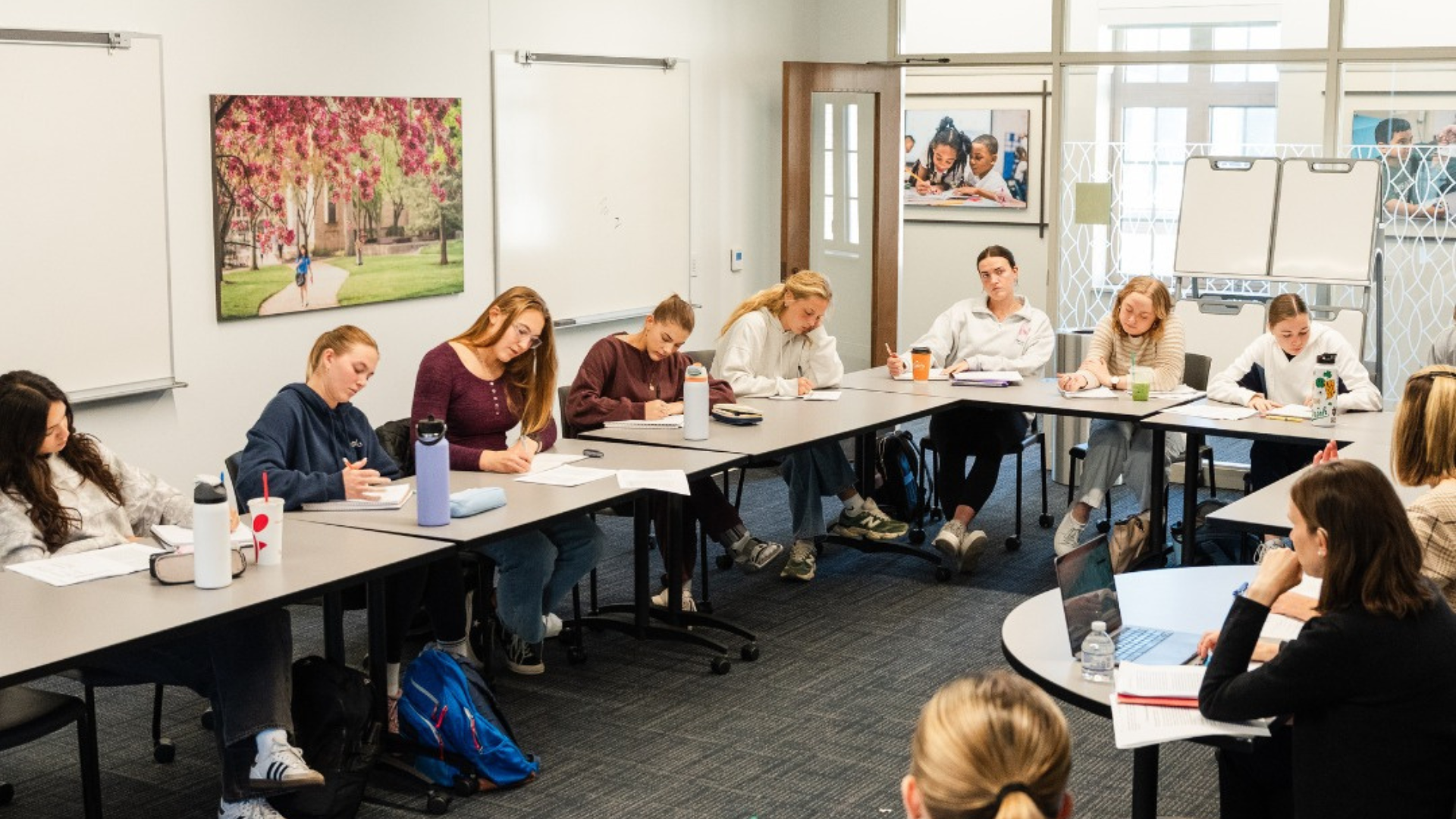
“It was great getting lunch. I’ve got to run to class now,” I say.
“Sounds good, what class you off to?” a friend inquires.
“Catholicism, Sex, Law, and Politics.”
I can still picture the somewhat amused and confused look that always followed.
Most of my friends thought the combination of so many massive topics was a bit absurd for a class, especially such decisive topics, and numerous people brought up that these are all things you’re usually supposed to avoid talking about. One of my friends began calling it “sex class” to which I retorted “it’s more like how not to have sex class,” which it was, and it made me really happy that Notre Dame was offering a course that explicitly emphasized a lot of aspects of Catholic morality that many struggle with or do not fully understand.
As someone who has taken up women’s issues as a side passion, I was so excited to finally have some formal direction in my studies, and this class was exactly that. We looked at what it means to be human, what it means to have a biological sex, and what the role of government should be in issues related to gender, work, and the family. We read from the perspective of the Catholic Church, ancient philosophers, Enlightenment thinkers, and first and second-wave feminists.
Some of my key takeaways from this class, either from the content or my own personal reflection are as follows.
- The pattern of giving and receiving. Christ gives first, the Church receives and then gives back. This is modeled in sexual procreation.
- New interpretation of Genesis. In Genesis 3:16, when God says to Eve that her husband will rule over her, this may be a prophecy of the broken state of nature rather than Him laying down a new order.
- Hebrew. When God creates man, He calls His creation ‘āḏām, but once they are male and female they are called ‘‘îš and ‘iššâ.
- Finally clarity on Ephesians 5. Christians are told to submit to one another (Ephesians 5:21), but then wives are highlighted as having to submit to their husbands and men are highlighted as having to love their lives with a selfless and sacrificial love. The only uneven submission between the spouses is if the husband wants to sacrifice for his wife. She should let him. (I have an upcoming post on this)
- Abortion and birth control make pregnancy and fertility a woman’s problem instead of embracing them as an essential and beautiful part of humanity.
- Men are suffering too. Even during the “golden age” of the 1950s, they were unfulfilled with monotonous and meaningless work. Now, they’re falling behind in school and feeling without purpose.
I’ve attached the three papers I wrote for the class. Essay 1 details what exactly the Catholic Church teaches on how exactly our biological sex does inform our vocations as part of a family. Essay 2 analyzes how first and second wave feminism differ in their approaches to sexual asymmetry, the fact that women have an increased burden in childbearing compared to men. The final position paper are my personal beliefs on the questions the course has presented us with and what types of policy would best address our reality where women and men do not fit so neatly into boxes.
Also: check out this article from the Center for Citizenship & Constitutional Government about the class.