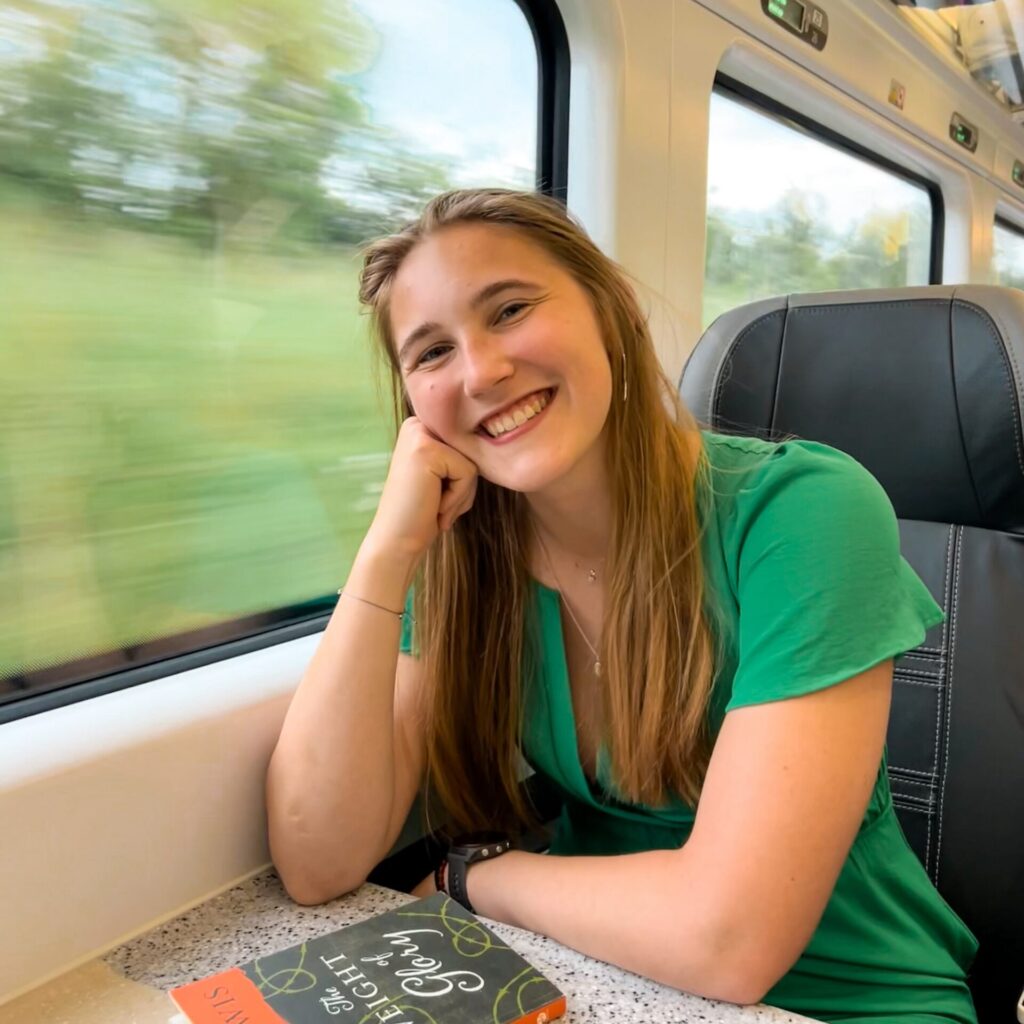
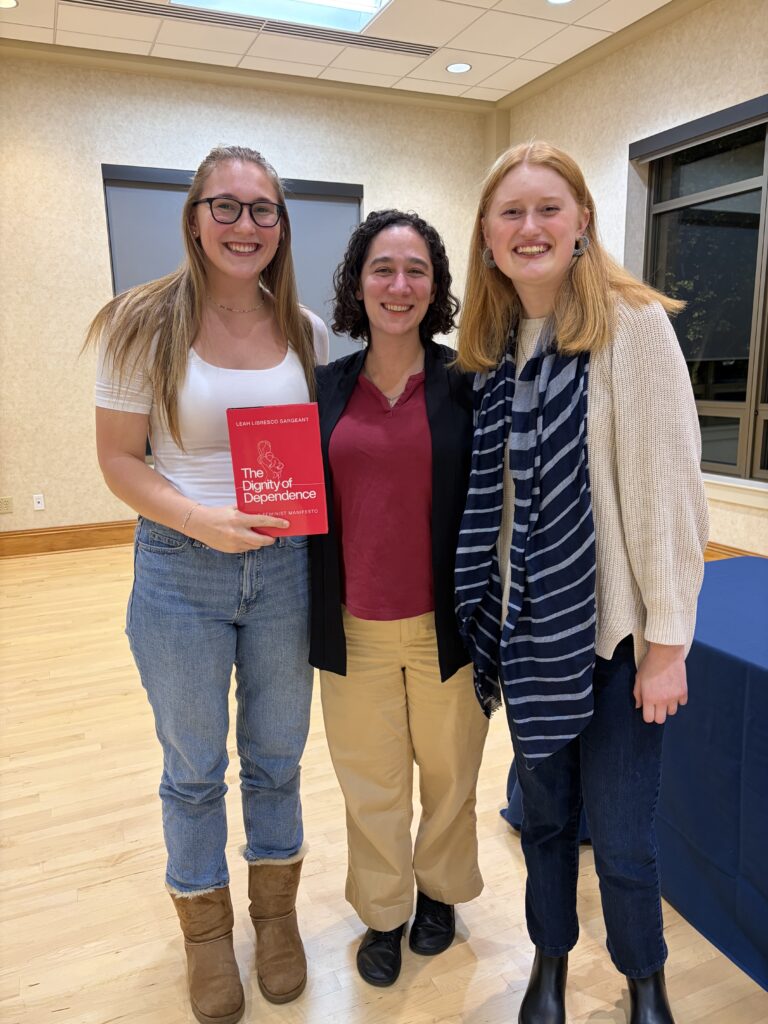
Yesterday, I had the opportunity to meet Leah Libresco Sargeant as the tour for her new book, The Dignity of Dependence, made a stop at Notre Dame. She was so personable and fun to interact with, and she ended up starting a bit late because she was playing with a baby brought by one of my mutual friends. This was a perfect start to her talk, as she was valuing a life that is entirely dependent.
Sargeant began by presenting a misconception, the first of many over the course of the evening. That misconception was that people view something as equal if it is interchangeable. We use interchangeability as a proof that two things are the same. However, men and women are not interchangeable, and we fear that if we acknowledge that then we will lose the claim on our equality. This is not the case. On average, women are smaller and weaker than men. Women are affected by childbirth much more than men, and this reality means that women are confronted by the idea of dependence much sooner than men. They begin contemplating what it would be like not only to have a dependent baby but for them to be dependent on another during the vulnerable time of pregnancy and postpartum care.
The world seems to believe that loving fragile people or being a fragile person means having our freedoms taken away and that to be human is to have autonomy. This is the erroneous thinking that her entire book seeks to combat. From a Christian perspective, I think it is quite easy to see that being human is not based on autonomy. The entire universe, humans included, is dependent on the will of God. At every moment, He is the reason that there is something rather than nothing. If we truly wanted to be autonomous, it would last for a negligible amount of time because we would blink out of existence. Sargeant cited the following quote from St. John Henry Newman which was new and delighting to me:
We cannot be our own masters. We are God’s property by creation, by redemption, by regeneration. He has a triple claim upon us. Is it not our happiness thus to view the matter? Is it any happiness, or any comfort, to consider that we are our own? It may be thought so by the young and prosperous. These may think it a great thing to have everything, as they suppose, their own way,–to depend on no one,–to have to think of nothing out of sight,–to be without the irksomeness of continual acknowledgment, continual prayer, continual reference of what they do to the will of another. But as time goes on, they, as all others, will find that independence was not made for man–that it is an unnatural state–may do for a while, but will not carry us on safely to the end. No, we are creatures; and, as being such, we have two duties, to be resigned and to be thankful.1
This is a beautiful reflection. From the very beginning, “It is not good that mankind should be alone” (Genesis 2:18), but today that sentiment is heavily amended. People may consent that being lonely is not good, but they still idolize independence. They believe that you should default to being able to do things on your own and only if you fail (which is somewhat shameful to have done), then can you grovel at the feet of another and ask for help. Being together is good, but humans exist in a default state as individuals. This idea reminds me of Elizabeth Cady Stanton’s “Solitude of Self” address which I recently read in my class Catholicism, Sex, Law, and Politics. Stanton advocates for equal rights on the basis that all humans are at their core, solitary beings, and no woman should have to rely on someone who is not herself (such as a husband) to take care of her. While she is correct that men should have equal rights and that women should not have to rely on men to take care of them, her analysis of the human condition misses. Where Stanton says that the human soul is fundamentally isolated, Sargeant, along with a distinct tradition of feminism, would say that to be a human being is to need others. Fr Kevin Grove, C.S.C, a Notre Dame professor whom I had the pleasure of working for my sophomore year, drilled into our brains that to be human is to be related in love. Sargeant’s approach to feminism and to dependence is much more in line with this. In her talk she said, “Because our love exceeds our strength, we need others.” We should be loving other people so fiercely and so wholly that in order to express this love, we often need help from others. This is something to be proud of, not ashamed of.
Because our love exceeds our strength, we need others.
However, we usually are ashamed of needing others. A mild example Sargeant gives is the choice to pay a stranger to bring us food (such as ordering DoorDash) instead of asking a friend to pick something up for us or even cook us a meal on a hard night. When I first heard this example, I thought to myself that it would be so weird and uncomfortable to ask a friend to do this for me, but also if a friend asked it of me and I didn’t have anything pressing preventing me from doing it, I would absolutely love to help them out.
A much scarier example she gives is choosing medical assistance in dying (MAID). Sargeant cited a study done in Oregon that looked into why suffering people chose MAID by giving them a list of reasons for the request and having them rank the importance of those reasons on a scale from 0 to 5.2 Here are some notable scores:
| Wanting to control circumstances of death | 5 |
| Fear of poor quality of life in future | 5 |
| Loss of independence in future | 5 |
| Loss of dignity | 5 |
| Fear of inability to care for self in future | 5 |
| Fear of worsening pain in future | 4 |
| Poor quality of life | 4 |
| Perceived self as burden to others | 3.5 |
| Not wanting others to care for him/her | 3.5 |
| Loss of independence at time of request | 2 |
| Pain at time of request | 2 |
People are literally choosing death over being dependent on others, viewing this as being a burden and degrading their dignity. As this study was a bit older, published in 2007, I looked for a more recent one and found a 2018 study with similar results.3 In this study, patients were asked about their reasoning to opt into MAID and their top two answers were recorded. While the leading reason was “Illness-related suffering,” which was given by 60% of respondents, 53% cited “Loss of control and independence.” If we view dependent humans as less than human, this data makes a lot of sense.
Sargeant shared that she intentionally chose to use the word “dependent” in her title despite being urged to swap it for “interdependence.” We only feel good about receiving if we know that we have something to give back. It is okay to be a person who needs other people all of the time. This quip of hers was especially acute: “There are no non-disabled people. There are people who are temporarily able.” Not only do we take our autonomy for granted, but we use it to define our humanity. If you got hit by a car or diagnosed with a rapid-onset illness tomorrow and had to start relying on your family and friends for basic needs, your life would not lose its value, your dignity would not be lessened, and your humanity would not be tarnished.
There are no non-disabled people. There are people who are temporarily abled.
I asked Sargeant what are practical things that would help promote a culture that does not shun dependence. Her answer was threefold. 1) Zoning and neighborhood layouts should be changed to create more integrated communities. If communities are more walkable, that will promote interactions between neighbors. Additionally, she supported having a type of secondary housing so that aging parents could live right next door. 2) There should be financial benefits for homemaking. Social security should give caregiving credits to people who take time off from work to take care of children or the elderly. A baby bonus would also help families get started. 3) Ultimately, euthanasia and abortion must be banned. If we view someone as legally able to be killed, we will never view them as fully human. The elderly and the unborn are the most dependent, but they are equally human.
The action item that Sargeant left us with and that I will leave you with is to ask for help in something you could do yourself. (surprise: your family and friends would love to help you)
Sources
- Newman, John Henry. “Sermon 6. Remembrance of Past Mercies .” Works of John Henry Newman, vol. 5, https://www.newmanreader.org/works/parochial/volume5/sermon6.html. ↩︎
- Ganzini, Linda, et al. “Why oregon patients request assisted death: Family members’ views.” Journal of General Internal Medicine, vol. 23, no. 2, 15 Dec. 2007, pp. 154–157, https://doi.org/10.1007/s11606-007-0476-x. ↩︎
- Wiebe, Ellen et al. “Reasons for requesting medical assistance in dying.” Canadian family physician Medecin de famille canadien vol. 64,9 (2018): 674-679. ↩︎