A traditional American woman, a beautiful wife and mother who sells her pioneer lifestyle of raw milk and farm-fresh eggs to her millions of social media followers, suddenly awakens cold, filthy, and terrified in the brutal reality of 1855—where she must unravel whether this living nightmare is an elaborate hoax, a twisted reality show, or something far more sinister in this sensational debut novel.
That is the book I thought I was going to read. That is the book that was marketed. Here is how I thought this book was going to go:
Our tradwife is a conservative Christian with a sweet but imperfect family. She is rather judgmental of those who don’t align with her beliefs (politically, religiously, and socially) but genuinely does her best to love the people in her life. She is blessed to not have to worry about money and is able to live her dream “cottagecore” life (perfected for the camera of course), all while growing a successful following and business from social media. Then, she is suddenly in the harsh world of the real pioneer lifestyle. The book focuses on how she grows during this time. She is pushed physically like never before. She is disrespected as a woman by all men, even her loving husband. She becomes grateful for modern life, for the technology that she once complained was making humans lazier, for the progress of feminism which she once belittled, for the gradual end of weaponizing Christianity for sexism and racism. When she returns to her normal life, she is a changed woman. She understands that “the good old days” were far from that, and that the present is the best world she could have imagined.
If you would like to read a book like what I have described, you should go write it, and I would gladly buy a copy. Yesteryear, by Caro Claire Burke, is not that book, not even a little bit.
Yesteryear spoilers ahead.
In reviewing this book, I do have to give credit to what I enjoyed because I tore through this book. The writing is fast-paced and vivid. I understand Natalie’s longing to feel a purpose, and I am rooting for her to find it. We progressively see her making more drastic decisions, and there is intense suspense throughout the story.
Now, onto the much more interesting part. Ultimately, I think Yesteryear was hypocritical when it meant to be insightful and divisive when it could have been unifying.
Hypocrisy
Natalie dubs her haters “the Angry Women.” An Angry Woman is just a woman who is career-focused, but Natalie adds a very negative connotation. To her, all Angry Women hate children, sleep around, create drama, and are deeply unsatisfied with their lives. At the end of the novel, Natalie is reunited with Reena, her former college roommate and exemplar Angry Woman. Throughout the book, Natalie has criticized Reena from afar, seeing how much she has struggled and failed in the professional world and assumes she is absolutely miserable. When we finally get to meet her again, she is doing very well for herself.
The point Burke seems to have been trying to make was that the Angry Women might struggle but they eventually do succeed and are fulfilled. The point she actually got across is that she is ignorant and judgmental just like Natalie. In Yesteryear, Natalie thinks there is no way Angry Women are content and fulfilled. In the real world, it seems Burke thinks the same thing about tradwives because she wrote Natalie as a character who is discontent, unfulfilled, and forcing herself to like the lifestyle. Just as Natalie is smugly content not to be an Angry Woman, it seems that Burke feels the same way about being one.
Missing the Mark
I thought this book was intended to be a commentary on the rise of women advocating for a return to focusing on the home life. Whatever point it was trying to make here was completely nullified by the fact that Natalie clearly has a mental disorder. She is not the archetype of your average tradwife. She is Amy Dunne from Gone Girl if she had Instagram. Translation for those of you who have not read/watched Gone Girl: she suffers from intense personality dissonance and narcissism and is not far from a legitimate psychopath. Characterizing Natalie in this way furthers the hypocrisy. In order for someone to want to be a tradwife, they must be clinically insane, is the message I took away. For the seemingly intended audience of Angry Women, all this does is further alienate the lifestyle they disagree with. Had Natalie been perfectly sane (as most real life housewives are), this book could have been humanizing. It could have brought women together instead of poking fun at a twisted tradwife caricature.
This book was advertised to be about the jarring cultural shift for a conservative woman taken to the 1850s from the present, but there is a lack of real insights to why a woman might long for “the olden days” and why those desires might be problematic. I thought this book was going to be about the problem of tradwife influencers, but it seems to only focus on the problem of being an influencer, and the biggest issue at the intersection of tradwives and influencers is ignored. Most influencers, tradwives or not, are faking and brushing up their content to misrepresent reality. This is a completely separate issue from being a tradwife. Burke casts her valid criticism of influencer culture onto tradwives. However, there is a unique issue at the overlap between influencers and tradwives: filming kids. Filming kids to post on social media is definitely wrong, and it seems to disproportionately permeate conservative, family social media accounts, such as the infamous case of Ruby Franke. This could have been an area where real criticism is warranted, but for some reason, Natalie does the most awful things, but when her daughter asks her to stop filming, she listens. This makes me so frustrated because here is a perfect place to critique what is the biggest problem with tradwife influencers, and Burke explicitly avoids it. I love making Venn diagrams, and I have made one to sum up how Burke misses the mark.
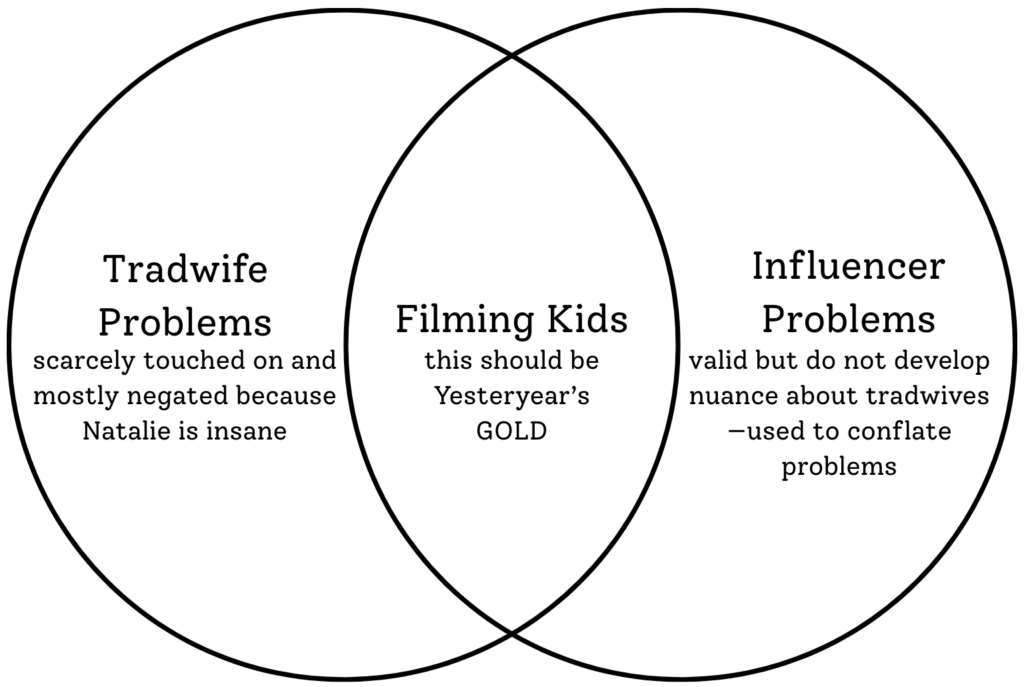
Ultimately, Natalie does not learn from her time in the past. A very small portion of the book is spent in the 1850s, not giving it enough space for Natalie to undergo some serious character development. The synopsis of the novel was extraordinarily misleading. Burke had a goldmine of a premise, but when it actually came to fleshing it out, it seems she got carried away with focusing on how psychotic and hateful she could make her Christian influencer. Any discourse about the logical appeal of being a homemaker is completely sidestepped, and a conversation about this book would be just about everyone saying, “Wow, Natalie is crazy.”
Christianity
As a Christian myself , I will always stand up for Christianity. I have seen Christianity portrayed as villainous so many times. Fantasy novels will even invent a religion that is clearly supposed to be analogous to Christianity just to use it as a force for oppression. This is very frustrating. Yes, I know historically, Christianity has been used to justify horrible actions, but I also know that historically, Christianity has been an impetus for incredibly charitable and justice-focused incentives. In real life, a lot of Christians do not live by the values they preach (or they do, but their values are dubiously-founded), but a lot of Christians are kind, moral people. Yesteryear is another sad example of using Christianity as an antagonistic force.
This book would have been so much more interesting if Natalie were actually a loving Christian. Explore the uncertainty she feels not knowing exactly what it means to submit to her husband or what her role as a wife means. Explore the crisis she feels wanting to love everyone but standing firm that the LGBTQ+ movement goes against her core beliefs. Make her involved in her community, a place where she draws lots of support but also feels tempted to compare her family to those of others. Natalie would be so much more complex and nuanced if she were portrayed as an actual Christian.
On that note, it seems the author did not do her research on Christianity. Maybe I am being too nitpicky, but if you want to stereotype my religion as a front for oppression, then I will reserve the right to be nitpicky. Natalie holds very conflicting beliefs within the realm of Christian doctrine. She is against birth control, mentions saints, and does not believe in divorce. These would all point towards being Catholic. However, she also uses fake wine at church, refers to the entirety of the church with a lowercase ‘c’ (a Catholic would use uppercase), references “spiritual communion,” and clearly does not go to a physical church in person every Sunday. Paired with her very conservative political beliefs, these line up with some kind of evangelical Protestantism. In the book, one college student types her as being Catholic and another as being Baptist. She is clearly neither! There is no Christian denomination that her beliefs align with. It seems Natalie just became a sink of convenient stereotypical Christian beliefs.
Sexuality
I read the word ‘penis’ more times than I was expecting to, which I did not particularly appreciate. That aside, one heavily emphasized part of this book is that Natalie’s husband Caleb is unable to maintain an erection with her, which Caleb explains is because Natalie feels like a dead body. This felt very unnecessary and almost like another jab at Christianity. When you wait for marriage to have sex, it might be so terrible. Cool.
Natalie does not seem to have this problem in the 1850s with “Old Caleb,” a man who is supposedly her husband. Natalie is absolutely terrified. To her, this man is a stranger who is attempting to rape her. She even uses the word rape, but then thinks to herself, “There’s no such thing as a husband raping his wife.” During her first time with Old Caleb, the way he treats her is debasingly rough to the point she describes herself as “a barnyard animal.” Then, it feels good, she is happy, and their sex life takes off. This was rape, but it is being grotesquely fetishized as a sheltered Christian woman finally being sexually satisfied.
In the book I was hoping to read, our protagonist would have learned about the reality of marital rape, and it would have been uncomfortable and frightening to read. Sarah Grimke, a feminist and abolitionist actually alive in the 1850s illuminated the horrors of this very common act. In the real 1850s, women did not like being raped by their husbands (surprise!). It was not a fun, kinky time. It was mortifying and often dangerous, as it led to pregnancies in close succession. Women faced increased risk of dying in childbirth, and children were malnourished from breastfeeding ending too soon. Not only is marital rape is a crime now, but the culture around consent has shifted as well thanks to the work of feminists. Natalie could have faced this head on and been grateful for the relationship she does have with her husband, where he never forces her over her boundaries. Instead, this book puts forth that a rapist who is good at sex is better than a respectful man who is not.
Final Thoughts
I put this book on my “not-mad-just-disappointed” shelf on goodreads. I am very, very disappointed. While the author can write whatever she wants (and honestly, this was her debut, she has so much potential and should keep writing), I am disappointed in the overwhelming positive reviews of this book—currently at 4.15 stars on goodreads. Anything over 4 usually means it’s good stuff. I imagine a lot of women, women who might self-identify as Angry Women, had a great time looking at how psychopathic this tradwife is. I had been hoping that this book would have meant everyone across the tradwife-Angry Woman spectrum would be forced to reevaluate where their convictions come from about what makes life meaningful and how they judge others, but I am instead, not mad, just disappointed.